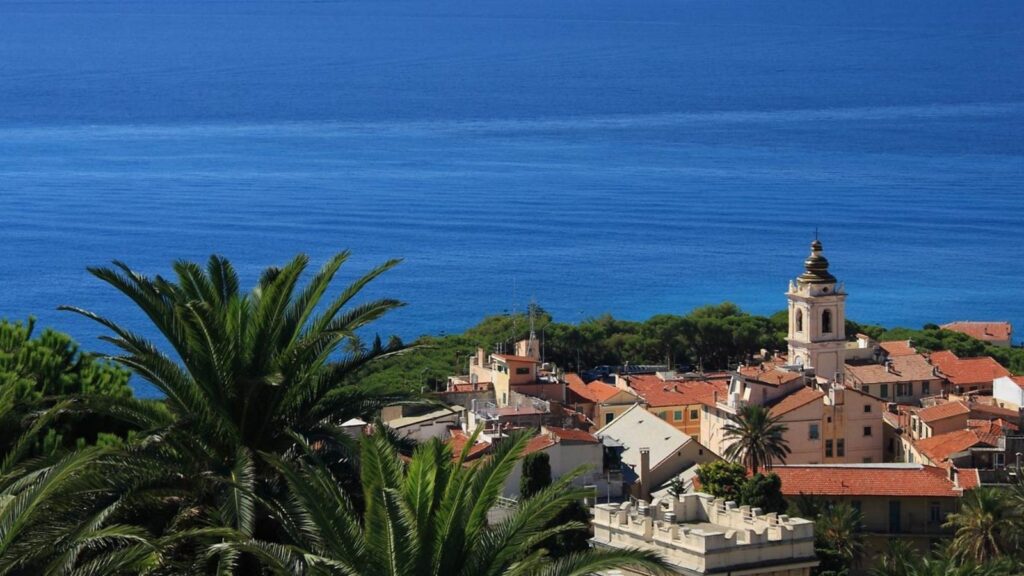
The history of Hotel Marligure and its Bordighera
I don’t have notarial deeds on the building at Via Aurelia 22. What I do have comes from the Imperia Chamber of Commerce archives, the old PagineGialle directory editions (the hotel appears in listings from the mid-1990s onwards, with the same room count), and the fact that the building’s location is typical of postwar Italian coastal construction — main road, sea-facing, no Liberty-era flourishes you’d find on the older grand hotels of the centre.
Best guess is that Hotel Marligure was built during the 1950s-60s tourism boom, when the Riviera dei Fiori filled with mid-sized three-star hotels aimed at Italian families on their two-week seaside holiday. The 39 rooms put it in the medium category — not a grand congress hotel, not a tiny family pension. The classic in-between that suits family management, which is how most Ligurian hospitality has always run.
Bordighera before Hotel Marligure
To understand where the hotel sat you need to know what Bordighera was long before. Through most of the 1800s this was a small coastal town of fishermen and olive farmers. The turning point was 1855: the Italian-British writer Giovanni Ruffini published Il dottor Antonio, a romance set here. The English read it. They started coming. By the 1880s Bordighera was effectively a British colony — the Anglican church here was the second built in Italy, after the one in Rome.
In 1879 Queen Margherita of Savoy arrived, eventually building a villa here (Villa Margherita, today’s town hall). In 1884 Claude Monet showed up — he spent four months in Bordighera painting around fifty canvases, including the famous views of the Moreno gardens and the Aurelia itself. Charles Garnier, architect of the Paris Opéra, chose Bordighera for his holiday house: Villa Garnier still stands 1.8 km from our address, in a panoramic position.
By the time the Marligure was built, decades later, all this history was already settled. Bordighera had lost its British-colony air (two world wars did their work) and become a mass Italian holiday destination. The Aurelia, where the hotel sat, was the spine of the region — the old Roman consular road built in 241 BC by consul Aurelius Cotta to connect Rome to Gaul.
The building on Via Aurelia 22
The hotel had the marks of a mid-century property:
- 39 rooms on several floors with a lift
- 82 beds total
- Rooms with balcony, telephone, colour TV, safe, eventually wifi
- In-house restaurant including dietary cuisine
- Bar and piano bar
- TV lounge, reading room
- Solarium and garden
- Private parking and garage
- Small conference room
Across its TripAdvisor lifetime it accumulated 92 reviews. Mean 3.6 of 5 — best subscores for Location (4.1) and Cleanliness (3.8), softest for Service and Rooms (both 3.5). The classic profile of an honest three-star: rooms a bit dated, but well-managed and in an outstanding location.
Why it closed
I can’t say with certainty when the last guest checked out. The domain was released in May 2026, which means the property no longer operates under this name — either closed permanently or rebranded under different management. The Ligurian hotel sector lost more than 20% of its small-and-medium independent properties between 2010 and 2025, replaced by privately-owned B&Bs or absorbed by chains. The Marligure’s story fits the broader pattern.
What remains
The physical building still stands on Via Aurelia 22. For visitors who want to see it, how to get to Bordighera covers the transport. And if you’re interested in present-day Bordighera — the town that continues after the Marligure — there’s a separate page on what to do in the area.
Historical information about Monet, Garnier, and Queen Margherita is verifiable in the Bordighera municipal archives. Data on the property comes from the original site’s Wayback Machine snapshots (2018) and the Marligure’s TripAdvisor listing.