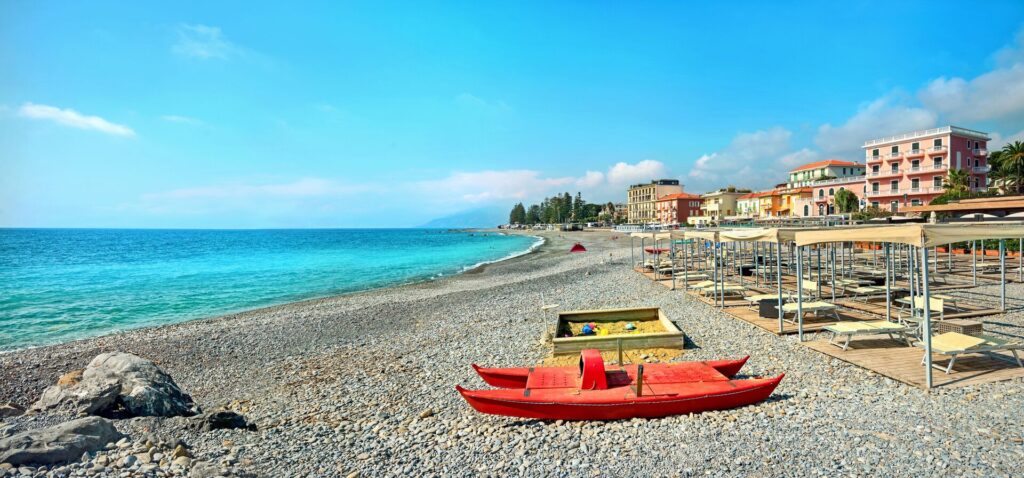
When to visit Bordighera
Bordighera has a famous microclimate. The palm trees you see lining the streets aren’t postcard decoration — they’ve been cultivated here for centuries, and by a papal privilege from 1586 the woven palm fronds of Bordighera are the ones the Vatican uses on Palm Sunday. The story behind the privilege involves a local sailor named Bresca, who saved the raising of the Vatican obelisk in St Peter’s Square — Pope Sixtus V granted him in return the perpetual monopoly on supplying palms. Since then the Vatican’s palms have come from here every year.
That aside, it’s a town you can visit any time of year. Each of the four seasons has its own thing.
Spring (March–May)
The best window if you want a mild climate, the sea already blue, and prices not yet summer-level. Mean temperatures 15-22°C. Mimosa is in bloom from February, but the real season opens with Bordighera in Fiore (usually April; check the municipal site for exact dates). The cycle path is busy but not packed like August.
The Hotel Marligure used to run a February/March offer with full board at €52 a day — a sign the local hospitality industry has long considered this a low-season window. Today the same months are favoured by European travellers wanting sun without crowds.
Summer (June–September)
High season, high prices, packed beaches. The Riviera di Ponente in August is one of the historic Italian-French summer destinations — anyone after quiet picks other months. That said, the seafront in summer has an energy the mid-seasons don’t match, and the swimming is at its best.
Notable events in the area:
- Monaco Grand Prix (late May) — not in Bordighera, but 30 km away. Bordighera hotels often serve as an overflow base for visitors avoiding Monaco’s rates.
- Festa della Repubblica (2 June) — public-holiday weekends fill up
- Local festas in Vallecrosia, Ventimiglia, Sanremo — weekly summer calendar
The Marligure considered “summer season” to run from 15 June to 15 September, which matches Ligurian custom.
Autumn (October–November)
My favourite stretch. Temperatures 18-23°C in October, the sea still warm from summer, prices down. The light around mid-October — that low oblique light of shortening days — is what drew Monet here in 1884.
November starts getting more variable, with possible rain. But even in rain Bordighera stays liveable — this isn’t a town that empties in low season, because real residents live here year-round.
Winter (December–February)
Here’s the part that surprises people: Bordighera winters are mild. Mean daytime temperatures 12-15°C, frequent sunshine, snow basically never (the famous exception was 1985). For someone coming from northern Europe it feels almost like spring. This is exactly why the British came here in the 1800s.
Events that fill the area:
- Sanremo Music Festival (February, 13 km away) — Bordighera hotels saturate from January onwards for festival weeks
- Carnival of Ventimiglia (February) — traditional, worth a visit
- The mimosa carpet — from mid-February into early March, the roads are streaked yellow
The Hotel Marligure was open year-round, which was uncommon. Many Bordighera hotels close between November and March, reopening for Easter. Anyone wanting a property always available had limited options, and the Marligure was one of them.
The actual question — when should you go now
If I had to recommend a single window for visiting Bordighera today, it’d be mid-April or October. Best climate, mid prices, no crowds. September is good but still “high season” by most hotel tariffs.
For getting here, see getting to Bordighera. For what to do, things to do in Bordighera.